
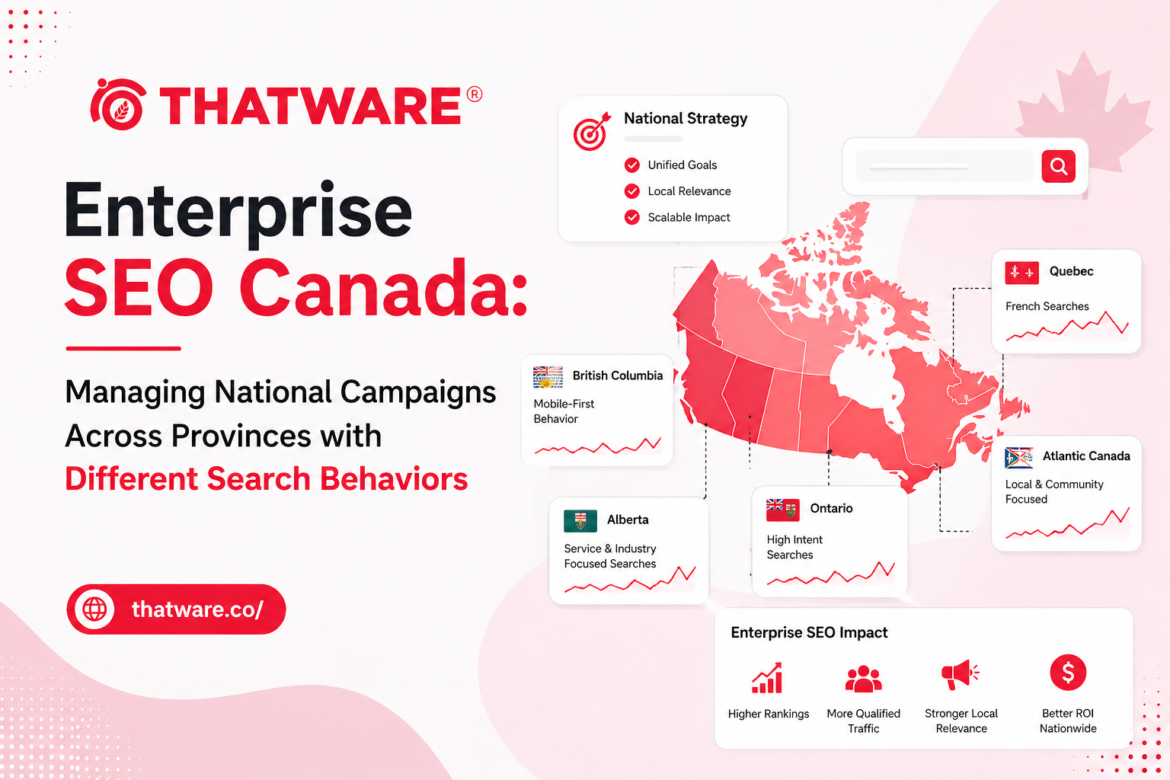
Running a national SEO campaign in Canada looks straightforward from the outside. One country, two official languages, a manageable geographic spread. The complexity emerges when you look more closely at how search behavior, competitive dynamics, and regulatory context vary across provinces in ways that a single national strategy doesn’t adequately account for.
Enterprise brands that treat Canada as a uniform national market in their SEO strategy are leaving organic opportunity on the table and sometimes creating content that underperforms in specific provincial markets because it doesn’t reflect the context those markets require. Getting this right at scale requires a structural approach to regional variation, not just awareness of it.
The French-English Divide Is Bigger Than Most Brands Realize
Quebec’s linguistic specificity is the most obvious regional variation in Canadian SEO, and it’s still underestimated by most national campaigns. The province has over eight million residents who search predominantly in French, distinct consumer behavior patterns from the rest of Canada, and a regulatory environment with specific requirements around French-language commercial communication under the Charter of the French Language.
For enterprise brands, this means that national SEO campaigns that treat French-language content as a checkbox rather than a genuine strategic priority are consistently underperforming in one of Canada’s largest provincial markets. Quebec City and Montreal represent significant commercial opportunity that English-first strategies with mediocre translation aren’t capturing.
Quality Quebec French SEO requires content written for Quebec French audiences specifically, not translated from English or adapted from European French. The vocabulary, cultural references, and search intent patterns in Quebec French are distinct enough that generic French content underperforms against content genuinely created for the Quebec market.
Enterprise seo canada programs that take Quebec seriously build separate content strategies, separate keyword research, and separate authority building for French-language campaigns rather than treating French as a variant of the English program.
Provincial Regulatory Variation in Regulated Industries
Canada’s regulatory federation creates a content challenge for enterprise brands in regulated industries. Financial services, healthcare, real estate, legal services, cannabis, alcohol, and several other categories operate under provincial regulatory frameworks that differ significantly across provinces.
Content that’s compliant in Ontario may not be compliant in British Columbia. Claims that are permissible under one provincial framework may be restricted under another. Product availability, pricing structures, and service terms that apply nationally often have provincial exceptions that affect how content should be written for provincial audiences.
Enterprise SEO programs in regulated industries need content governance that accounts for provincial variation. This often means either creating province-specific content variants for high-priority pages in regulated categories, or writing national content to the most restrictive standard across all relevant provinces, or implementing dynamic content that adjusts based on the user’s province.
Each of these approaches has tradeoffs in terms of content production cost, technical complexity, and ranking performance. The decision should be made deliberately based on the specific regulatory risk profile of the industry and the commercial importance of specific provincial markets.
Search Behavior Variation Beyond Language
Even within English-speaking Canada, there are regional search behavior variations that affect keyword strategy and content optimization for national campaigns.
Seasonal patterns vary by region in ways that matter for content timing. Alberta’s economy, heavily influenced by the energy sector, produces search patterns around certain commercial categories that differ from Ontario’s financial sector-dominated economy. British Columbia’s outdoor recreation economy affects search behavior in tourism and lifestyle categories differently from Prairie provinces.
Local terminology and vocabulary varies in ways that are subtle but consistent. Some product categories or service types have regional naming conventions that affect whether national keyword research captures the full demand picture for specific provinces.
Canada seo services programs doing national campaigns properly run province-level search data analysis alongside national keyword research to identify these variations and adjust content targeting accordingly.
The Ontario-Rest of Canada Problem
Ontario, particularly the Greater Toronto Area, accounts for a disproportionate share of Canadian search volume in many commercial categories. This creates a gravitational pull toward GTA-optimized content in national campaigns that can crowd out optimization for other provinces.
Enterprise brands sometimes find that their national campaigns are effectively GTA campaigns because the keyword research data is dominated by Ontario volume and the competitive landscape analysis reflects Ontario’s more saturated markets. This produces campaigns that perform well in Ontario while underperforming in western Canada and Atlantic Canada where the competitive landscape is different and more accessible.
Explicitly allocating analytical attention and content resources to non-Ontario provincial markets is the structural intervention that corrects this. It requires intentional priority-setting rather than letting data volume dictate where strategy focuses.
Building National Versus Provincial Authority
Link building and digital PR for Canadian national campaigns should deliberately include national media placements alongside provincial-level publications that carry authority for specific regional markets.
The Globe and Mail and National Post carry national authority. But provincial newspapers and digital publications, the Toronto Star for Ontario, the Vancouver Sun for BC, the Montreal Gazette for Quebec, carry local authority signals that matter for how pages rank in those specific provincial markets.
Enterprise link building programs that are focused exclusively on national media miss the provincial authority dimension that makes content perform better in specific regional markets. Allocating link building resources across both national and provincial outlets is the balanced approach for genuine national visibility.
The investment in treating Canada’s regional complexity seriously pays off in more complete national organic coverage. Enterprise brands that have done this properly consistently outperform those running genuinely national campaigns in terms of organic visibility across the full country rather than just in their largest market.